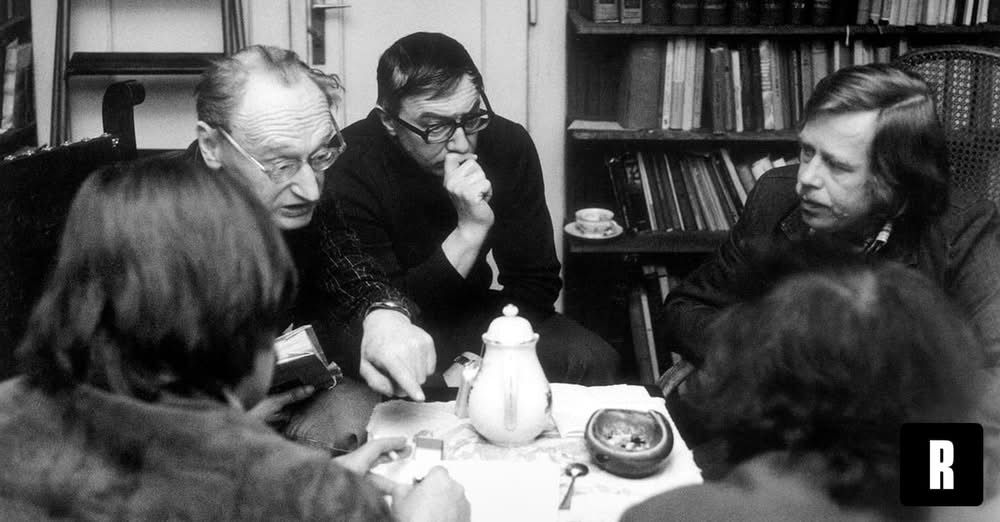
With the permission of Respekt magazine, we present here the full text of Alice Koubová's reply to Jaroslav Spurný's question.
In January next year it will be fifty years since the publication of the founding Declaration of Charter 77. Respekt asked twelve Czech public figures across the generations for a text answering the question of whether the activities and texts of Charter 77 have a chance of speaking to the present. Whether they can be of benefit to society in today's unpredictable world, in which nationalism and authoritarianism are growing stronger and there is a threat of the disintegration of communities that for long decades guaranteed security and peace. The texts of those approached form part of Respekt's series marking the anniversary of Charter 77, and we are now publishing the first six of them.
Alice Koubová, philosopher:
I certainly consider the legacy associated with the work of Charter 77 to be a sociopolitical inspiration. The signatories' texts can definitely speak to today's society, but I see the significance of Charter 77 above all in the fact that those texts functioned as public deeds, as political thinking embodied in particular human lives and with consequences for particular lives. This thinking vividly demonstrated how the power of the political system, the culture of society and the existential possibilities of the individual are interconnected. Let me sum up this relationship in several points:
1/ Charter 77 did not appeal for a change of the law in Czechoslovakia, but for the law to be observed. It stated that the Czechoslovak regime, which had itself enacted the Helsinki accords and publicly declared that it was abiding by them, was not abiding by them. The efforts of Charter 77 were therefore not trivially anti-system, but pro-system, in the sense that they were concerned with strengthening the rule of law and the integrity of the proclaimed system (democracy), which, had it been achieved, would have made totalitarian rule impossible.
2/ The repression that followed a relatively simple demand that the state do what it claimed to be doing reveals the other side of a post-totalitarian political regime: a profoundly corrosive mechanism directed against human subjectivity. It involves a certain enforcement of aggression upon the soul as the opposite of care for the soul. The regime not only committed violence while claiming to be liberating; it demanded that citizens publicly declare that they felt themselves being liberated while experiencing violence against themselves or against those around them. Under threat of punishment, they were not allowed to call the rule of arbitrariness and clientelism arbitrariness and clientelism, but freedom and democracy. If a person accepts this double-bind mechanism, they become at once a victim of the system and its accomplice (the powerlessness of the powerful). This is a state of self-aggression and apathy that destroys a person's self-respect, their confidence that they stand by themselves and can rely on themselves in their actions. In order to endure such a state, a person often denies it or externalises their own contradiction onto someone whom they can blame for the situation.
3/ With its emphasis on the general rule of law and on personal care for the soul, Charter 77 shows the extent to which the institutional and legal order is integrally bound up with individual freedom. Moreover, it is a platform that does not merely theorise but offers a way out of this political-psychological trap (the power of the powerless).
4/ The tension between a political regime and the individual may take the form of individual heroism in the face of repression, or of collective resistance. Charter 77 shows how essential it is to stand up to the arbitrary exercise of power collectively. Collective resistance does not efface individuality; on the contrary, it can save it: the Chartists were able to coordinate and to form a social bond despite radical differences in political opinion, lifestyle, faith or other identity. One attitude is essential to this bond: an unwillingness to be indifferent to injustice committed against others, the assumption that one cannot live a good life entirely undisturbed while violence is being done to others, because justice for others is part of justice for me. The political and personal stance of empathy and solidarity is, by contrast, extremely threatening to regimes founded on the dialectic of repression and subjugation. That is why they strive so hard to eliminate, ridicule, fragment, weaken and thwart it.
5/ Jan Patočka, and following him Václav Havel, linked the stance of the solidarity of the shaken with morality as a certain precondition for creating an environment in which something like politics can even begin to unfold. In my view, however, the work of the Charter shows the opposite: that trustworthy sociality is not an apolitical, pre-political or ideological dimension of democratic politics, but its very core. Functioning social ties, the possibility of relying on others, the possibility of experiencing conflict without violence, of finding a compromise and tolerating difference, are an internal brake against power turning into brutality, arbitrariness or chronic abuse.
Charter 77 is inspiring for the present from this structural point of view, because the phenomena it struggled with are not unfamiliar to us. We are facing, on a massive scale, tendencies to give words the opposite meanings and to use them for dominating others rather than for the rule of law; to shift responsibility onto those who have no means of defending themselves; to extort loyalty through threats and promises of gain over others; to attack every expression of solidarity, from the systemic level (investigative journalism, public service media, social programmes, protection of the vulnerable, non-profit organisations, independent culture, Europe's defence and responsibility) to individual human feelings (the spread of a culture of fear, xenophobia, deep-seated mistrust, insecurity and inner exhaustion). We rejected the Istanbul Convention as well as the solidarity-based agreement on defence spending among European countries. We are strongmen and cowards at once. It depends. Feathering our own nest.
The greater and the earlier society's resistance to the imposition of the logic of usurpation and force, the less we will need individual heroes to stand up against it at enormous personal risk. And the less we will need to justify ourselves before those heroes, to try to forget them or to attack them outright, in order to reassure ourselves inwardly that we are innocent, that the world is essentially cruel and that there is no way of acting in it other than according to the logic of (self-)violence.